Every conversation about AI right now skips the same step.
The demos are impressive. A model writes the report. A model summarizes the meeting. A model flags the anomaly. Watch enough of them and you start to believe the whole transformation is ready to plug in.
Then you try it on your own tasks, and the magic doesn't quite show up.
I've been thinking about why. The models are real. The capabilities are real. But the gap between the demo and the daily reality is wider than most people want to admit.
The gap isn't the AI. The gap is in the middle. It's the people doing the actual work, trying to figure out what any of this means for their Tuesday morning, while the technology keeps moving faster than anyone has a fair shot at keeping up with.
Everyone I talk to is somewhere on that stretch. Friends, colleagues, people inside the company, people running their own businesses. The pattern is the same. Experienced people who have built their careers solving hard problems are being asked to get fluent in something that didn't exist a few years ago. Nobody knows yet what to trust, what to hand off, or what to keep doing the way they've always done it. The headlines say the answers are obvious. The day-to-day says otherwise.
That middle space is where the real work is happening right now. And part of that work, the part I've been focused on, is the data sitting underneath all of it.
What I've been working on at Industria Innovations
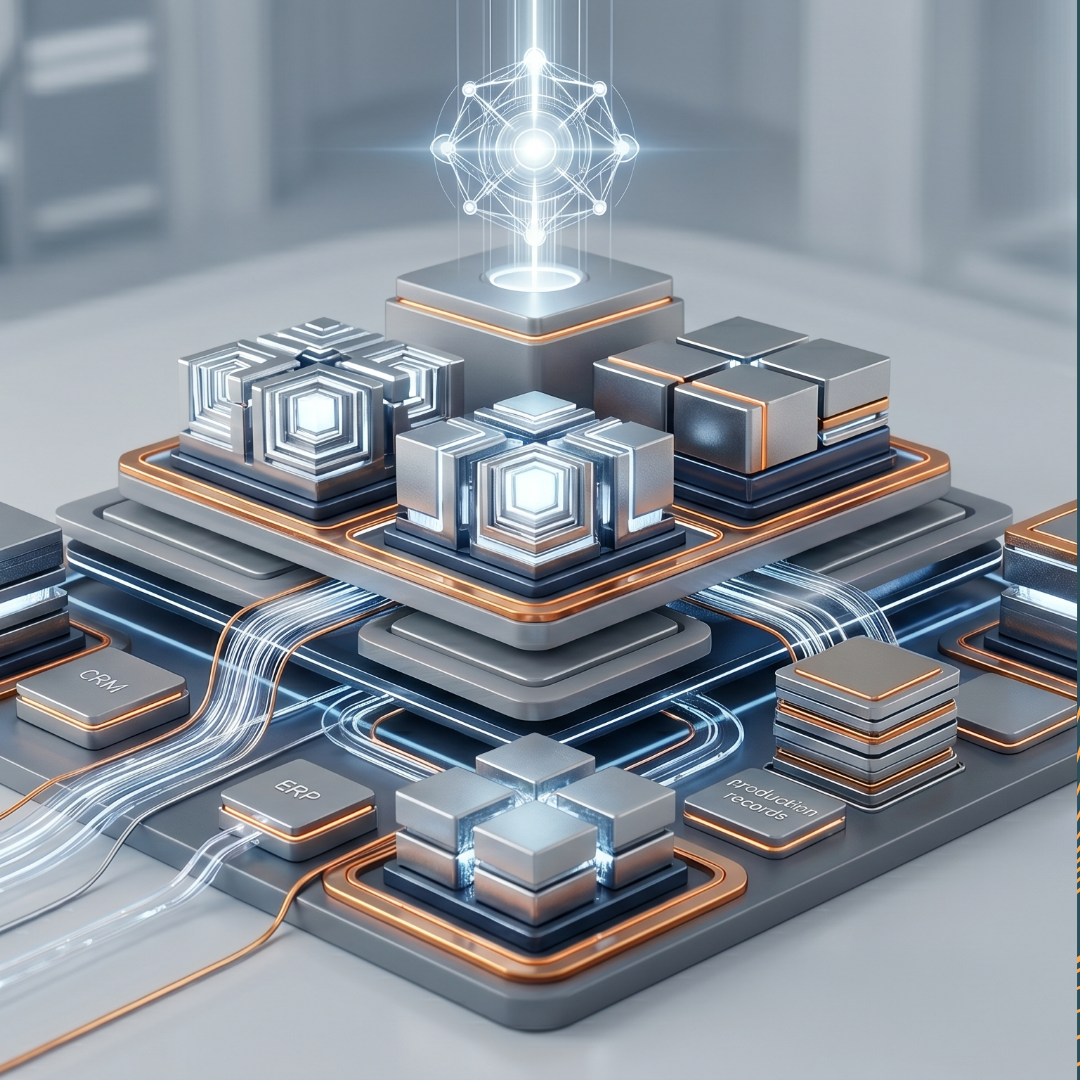
For years, my role has been about integrations. Pulling data out of one system and into another. Centralizing the CRM. Centralizing the ERP. Getting the reporting into one place. One project at a time, one system at a time.
Only recently did my thinking shift. The data that matters isn't just the CRM, or just the ERP, or just the reports. It's all of it. Every spreadsheet. Every process that lives in someone's head. Every note, every decision, every piece of context that makes this business actually work.
That's a much bigger definition of centralization than I used to hold. And what's changed is that the technology has advanced enough to make it realistic. Integrations that would have taken months now take days. Systems that never spoke to each other can finally be connected.
It's not glamorous. It doesn't make a slide. Nobody writes a headline about a company that finally cleaned up its data. But the longer I work on it, the more sure I am that this is the work that matters most right now. Everything else depends on it.
The real question underneath the AI question
When people ask me about AI in a manufacturing context, my honest answer is almost never about the AI.
It's about whether the data an AI would need to be useful actually exists in a form it can use. Is the project history reachable. Do the customer record, the production record, and the shipping record live somewhere they can be compared. Do the people who need answers have to dig through four systems to piece together one picture.
If those things aren't in order, no model will save you. A brilliant assistant with no access to the filing cabinet is still just standing in an empty room.
But if those things are in order, something genuinely useful becomes possible.
What it might look like
I've been thinking about what happens when AI can tap into a properly organized set of business data. Not through some clever workaround. Through a legitimate, permissioned connection, the way a trusted teammate gets access to the systems they need. Trust is the foundation. Without it, none of this works.
The possibilities aren't science fiction. They're common sense.
A project manager could ask the system to look across every active project and flag the ones that have gone quiet, the ones missing a milestone, the ones where the pattern looks like a problem from last year that ended badly. Not to replace the project manager's judgment. To make sure nothing slips while they're focused on the fires in front of them.
A designer could ask for the full history on a material. Not just what we ordered, but what customers said about it, what returns we processed, what the factory flagged in production.
An operator could ask if a decision they're about to make is consistent with decisions the team has made before.
None of this needs a breakthrough in AI. The breakthroughs already happened. What it needs is data that can be reached, in a place where reaching it is allowed.
Why this is the work
There's a temptation right now to chase the shiny thing. Build the tool. Demo the assistant. Put something on a screen that makes people say wow.
I get it. I've felt it. But the payoff comes from doing the less visible work first. The cleanup. The consolidation. The careful decisions about where information lives and who gets to ask it questions.
A manufacturing business runs on the quality of its information. It always has. What's different now is that when the information is clean, centralized, and reachable, it becomes a foundation for something new. Not just dashboards. Not just reports. A kind of always-available intelligence that can be pointed at whatever problem the day brings in.
What I keep coming back to
For a long time, the question has always been "what can this tool let me do?" You'd pick a platform, learn what it was willing to offer, and bend your thinking to fit. That's how most software has worked for the last twenty years.
What's changing is that the question is flipping. It's becoming "what do I actually want to build?" That's a completely different way to think about software, and it's the one most businesses have never been able to afford until now.
The way I see it, getting real value out of AI comes down to two things.
The first is the data. Clean, centralized, reachable. That's the work I've been doing at Industria Innovations. It's slow, it's quiet, and it's the foundation everything else sits on.
The second is what you choose to build on top of it. Every useful piece of software I've ever admired is really just an opinionated view of some underlying data. Somebody decided what mattered, what to show, what to hide, what to emphasize. The data made it possible. The opinion made it useful.
For a long time, building that view took a team. Someone who understood the business well enough to know what mattered. Someone who understood the data well enough to get it out. Someone who understood design well enough to put it in front of humans. Someone who understood engineering well enough to hold it together. Four specialists, minimum. A lot of meetings. A lot of budget. And after all of that, you'd often end up with something close, but not quite.
That's the gap that's closing. Most people know exactly what they want to see. They always did. They just never had the vocabulary, or the time, or the team to turn it into a real interface. Now the back and forth can happen directly between the person with the opinion and the tool building the view. You say what you want. The system shows you what it can do with the data on hand, and tells you what it would need for the rest. You adjust. It adjusts. What used to take months takes an afternoon.
For the first time, the person with the opinion and the person building the view can be the same person.
Here's the real question. Do you want a technologist building the opinionated view of your data? Or do you want to build your own?
Because when the data is in order, and the tooling is sitting right there, the limits aren't technical anymore. They're about your creativity and your curiosity. What questions you're willing to ask. What small experiments you're willing to try on a Tuesday afternoon.
So the question I'll leave you with isn't about AI at all.
What would you build, if you could build anything?